

BlockCompare Documentation
BlockCompare opens in Compare DWG mode; a Compare DWG / Compare with Excel switch in the title bar flips to comparing against an exported Excel workbook instead of a second DWG folder. Either mode then moves through one screen at a time: Select Files → Review Matches → a brief Comparing… progress screen → Comparison Report. There's no step indicator — each Back button returns to the exact previous screen instance (so its file lists, filters and edits are still there), and Finish on the report jumps two steps back to that same Select Files (or Select Excel) screen instance rather than to Review Matches — its file lists, filters and profile are still there too, exactly as Back would leave them.
Getting started
Screenshots reflect a recent release — minor visual details may differ from the version you have installed.
Comparing files
Compare DWG vs. Compare with Excel
A title-bar switch between the normal two-folder workflow and comparing an exported Excel workbook against one DWG folder.

- Compare DWG (the default) is the two-folder workflow described in the rest of this page. Compare with Excel replaces the Select Files screen's Folder A picker with a single .xlsx workbook — the block-data export produced by the companion BlockSync tool — while Folder B stays a normal folder of DWGs.
- Switching modes keeps each mode's own Select Files state intact — flipping to Compare with Excel and back to Compare DWG doesn't lose Folder A/B's file lists or filter selections.
Compare with Excel — selecting the workbook
Browse to the block-data workbook exported by BlockSync; Folder B is still a normal folder of DWGs.
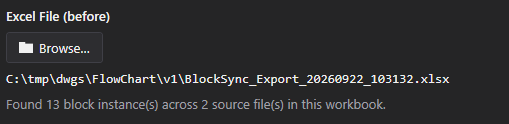
- Browse… picks the .xlsx workbook. Once picked, the screen reports how many block instances it found and across how many source files were originally recorded in it — e.g. "Found 13 block instance(s) across 2 source file(s) in this workbook." — before anything is scanned.
- The block names already present in the workbook become the comparison scope automatically; there's no separate Blocks/Layers/Viewports checklist for this mode, since the workbook itself already reflects whatever was selected when it was exported from BlockSync.
- From there it's the same Review Matches → Comparing → Comparison Report flow as Compare DWG, pairing the workbook's recorded file names against Folder B's actual files — Filename priority is the default match strategy here, rather than Hybrid, since the workbook side has no live handle data of its own to weight a Hybrid match with.
- An Excel workbook has no resolved layer color, so Layer name is still compared but LayerColor is left out of the diff for this mode — otherwise every single row would show a spurious color change.
Adding files (Folder A / Folder B)
Add the 'before' and 'after' revisions of the drawing set to compare.
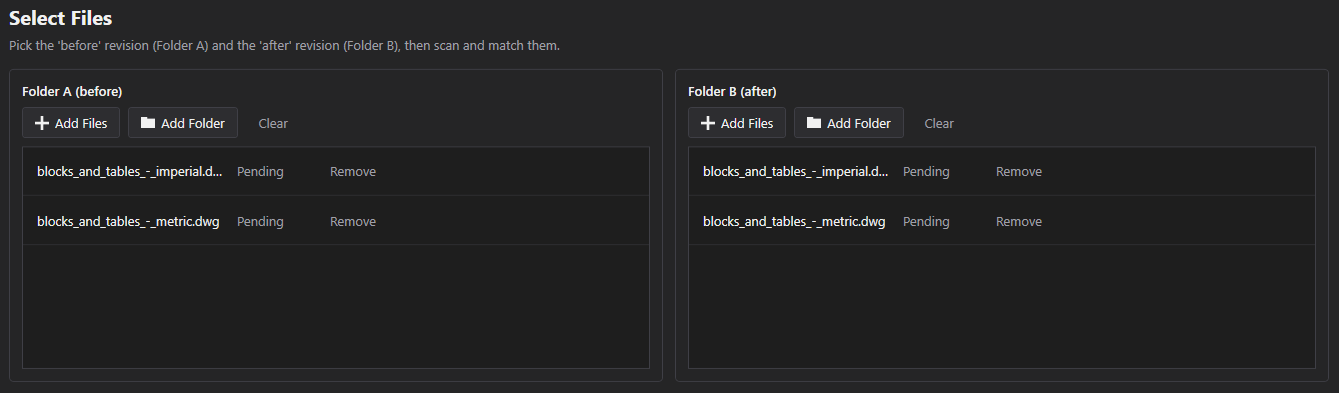
- Add Files or Add Folder builds Folder A (before) and Folder B (after) independently. Add Folder scans a whole folder for .dwg files — whether it also scans subfolders depends on "Include subfolders when adding a folder" (Settings → AutoCAD, off by default), which applies to both sides. Duplicate paths are silently skipped.
- Adding, removing or clearing files in Folder A automatically triggers a lightweight pre-scan to populate the Blocks/Layers/Viewports tabs below — Folder A's own Add/Add Folder/Clear buttons and list are disabled while that's running. Folder B is deliberately never pre-scanned, since its role is just to supply match candidates, not to drive the filter tabs.
- Each list shows File Name and a color-coded Status, with a per-row Remove button. With nothing added yet, the list shows "No files yet — add a folder or files above." instead of an empty table.
Filtering with Blocks, Layers and Viewports
Narrow what actually gets compared, based on what Folder A contains.
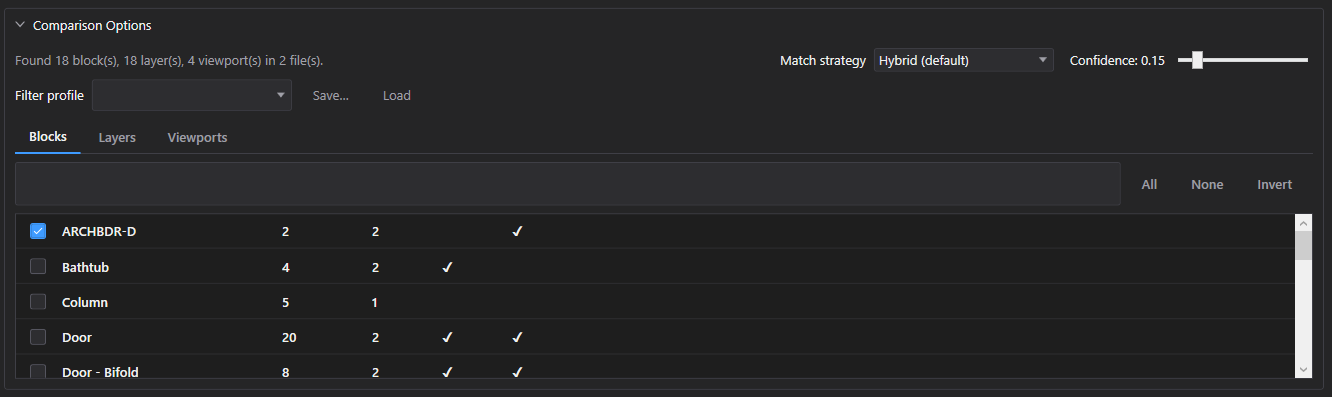
- The Blocks tab lists every block definition found in Folder A's pre-scan: Block Name, References, In Files, Dynamic and Has Attrs flags. Layers lists every layer name with a color swatch and In Files count. Viewports lists every paper-space viewport by Layout, Layer, Width and Height.
- Each tab has its own Search box; All / None / Invert act only on whatever the current search is showing, not the full unfiltered list.
- Checking nothing on a tab compares everything, as usual; checking specific blocks/layers restricts what Scan & Match reads in the first place, while a Viewports selection is applied as a separate bounding-box filter after scanning, keeping only block instances that actually fall inside one of the checked viewports.
- Unlike some of the other CADXChange comparison tools, there's a single shared Filter profile for all three tabs together (see the next section) rather than a separate saved profile per tab.
Match strategy, confidence and saved profiles
How BlockCompare decides which 'before' file goes with which 'after' file.
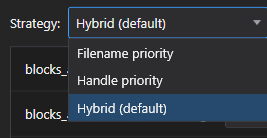
- Match strategy — Filename priority, Handle priority, or Hybrid (default) — sets how much weight a proposed pairing gives to filename similarity versus how many block handles two files share. Hybrid leans toward the handle signal, which is what keeps a match correct even when a revision also renames the file.
- The Confidence slider (0.00–1.00, default 0.15) is the cutoff a proposed pairing's combined score has to clear to be accepted automatically; a pairing that scores below it is left unmatched instead, for manual pairing on the next screen. Raising the slider makes matching stricter; lowering it accepts weaker guesses automatically.
- Filter profile Save… stores the current Blocks/Layers/Viewports selections under a name; Load applies a saved selection back, checking whichever rows match by name and leaving the rest unchecked. Free tier keeps one saved profile at a time — saving a second new name shows an upgrade prompt instead of silently replacing the existing one (overwriting the same name again is always allowed).
Scan & Match
Reads both folders and proposes file-to-file pairings — the step that actually opens every DWG.
- Free tier caps this at 3 files per side (Folder A and Folder B counted separately) — going over blocks the whole run before anything scans, with a message naming the limit, rather than scanning a partial batch.
- Scans Folder A, then Folder B, processing one file at a time in the background per slot; parallelism is capped at 1 for Free regardless of the Settings "Max Parallel AutoCAD Instances" value, so a Free scan always runs one file at a time. Each file's own MD5 hash is also computed here, used later to detect a byte-identical pair.
- A failed file is marked with its error and doesn't stop the rest of the batch from scanning; the failure carries through to matching as a file with nothing to pair against.
- Matching itself is a global optimal assignment across every Folder A/Folder B pair (not a simple nearest-match), so one file's best-looking pairing can't steal a partner another file needed more.
- There's no Cancel button anywhere in this step, and no automatic timeout — if AutoCAD hangs on a corrupt or unusually large DWG, the only way out today is closing the app and checking the log folder for the last file it was reading.
Review Matches
Confirm or correct the proposed before/after file pairings before anything is compared.

- Each row shows File A next to the proposed File B (an editable dropdown listing every Folder B file), with Filename %, Handle % and Combined % scores — these percentages reflect the originally proposed pairing and don't recompute if you manually pick a different File B from the dropdown.
- Rows highlighted red are conflicts — the filename-only best match and the handle-only best match for that file disagree with each other (or with the chosen pairing) — and name a Conflict candidate so you can see the runner-up before deciding.
- A Folder A file with no confident match starts as its own row with no File B selected and Exclude already checked — it's left out of the compare unless you pick a File B and uncheck Exclude yourself.
- Change Strategy and Re-match re-run the matching algorithm purely against the snapshots already scanned — no DWGs are re-read, so it's effectively instant, but it replaces every row, discarding any manual File B overrides or Exclude changes made since the last scan.
- Compare only becomes available once at least one row is both not excluded and has a File B selected.
Comparing (progress screen)
A short progress screen between confirming matches and seeing the report — no Cancel button here either.
- Confirmed pairs are compared one at a time, in order, with the progress bar and "Comparing {n}/{total}: {File A} vs {File B}" status updating after each pair finishes.
- This screen has no Back and no Cancel — it navigates itself to the Comparison Report automatically the moment the last pair finishes.
Comparison Report
Every matched pair, field by field — never just flagged as "different".
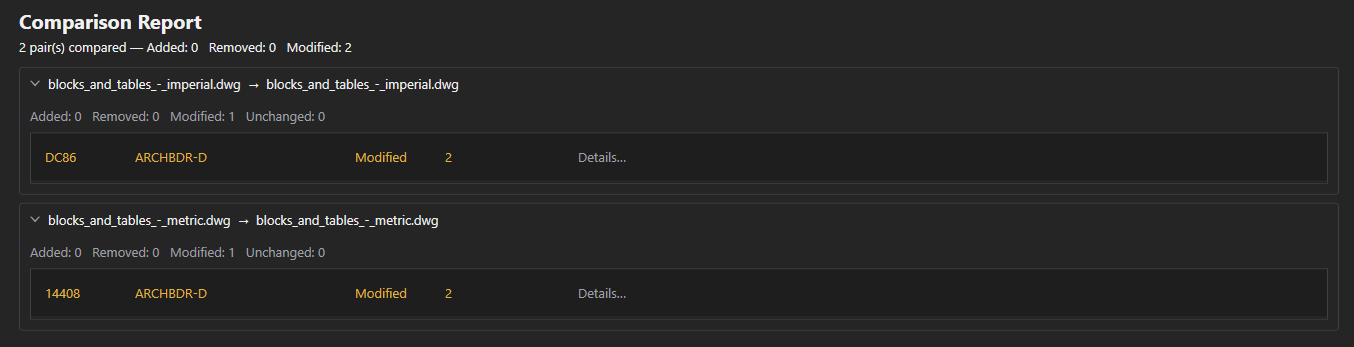
- Results are grouped per matched pair, each shown as its own expandable section headed "{File A} → {File B}". A pair whose files hash byte-identical is reported as "Identical file — comparison skipped." with no detail list at all — no per-block diffing runs for that pair.
- Differences are matched by AutoCAD's own persistent object handle, not name or position, so a block that moved or got renamed is still recognized as the same instance rather than reported as one delete and one add.
- Each entry shows Handle, Block Name, Kind (Added/Removed/Modified) and how many fields changed. Unchanged block instances are left off this on-screen list entirely — they're still counted in each group's summary line, just not listed row by row, so a drawing with thousands of untouched instances doesn't bury the handful that actually changed.
- Details… (enabled only when at least one field changed) opens a small popup listing every changed field's old and new value side by side; clicking a different row's Details while one is already open just retargets it, rather than requiring you to close it first.
- The page-level summary line intentionally leaves out the Unchanged count, even though each individual group's own summary shows it.
Exporting to Excel
Export to Excel
The same comparison, written to a workbook anyone can open without BlockCompare installed — including everything the on-screen report leaves out.

- One sheet per distinct block name across every compared pair, plus a metadata sheet listing app/AutoCAD version and every pair's own file names and MD5 hashes (so you can independently confirm which pairs were identical).
- Unlike the on-screen report, the exported sheet includes Unchanged rows alongside Added/Modified/Removed — nothing is left out of the file, only off the screen.
- Added rows are filled green; Removed rows are filled red with strikethrough text; Modified rows aren't row-filled, but every changed cell carries a comment recording its old value, so the new value stays visible in the grid while the old one is one hover away — this is the default "one row per record" layout described here; see the next section for the alternative.
- The Status column in the exported sheet uses different wording than the on-screen Kind column — "Deleted" and "Altered" in Excel versus "Removed" and "Modified" on screen — worth knowing if you're cross-referencing the two.
- There's no row-count limit or Free/Pro gate on the export itself — Free can export a report of any size; the only Free-tier limit in BlockCompare is the 3-files-per-side cap on Scan & Match.
Choosing a report layout
Export to Excel opens a small dialog first, asking which of two row layouts to write the report in.
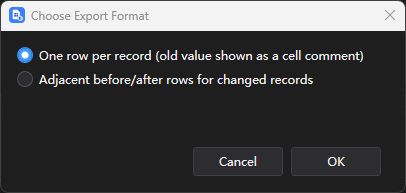
- One row per record (the default) is the layout described in the previous section: a changed field's old value rides along as a cell comment.
- Adjacent before/after rows instead expands every Modified instance into two rows — see the next section for what that looks like.
- The choice only affects how Modified instances are laid out; Added, Removed and Unchanged rows are written the same way either way.
Two-row before/after layout
The alternative layout: a Modified instance's old and new values sit on two adjacent rows instead of one, with the changed fields highlighted on both.
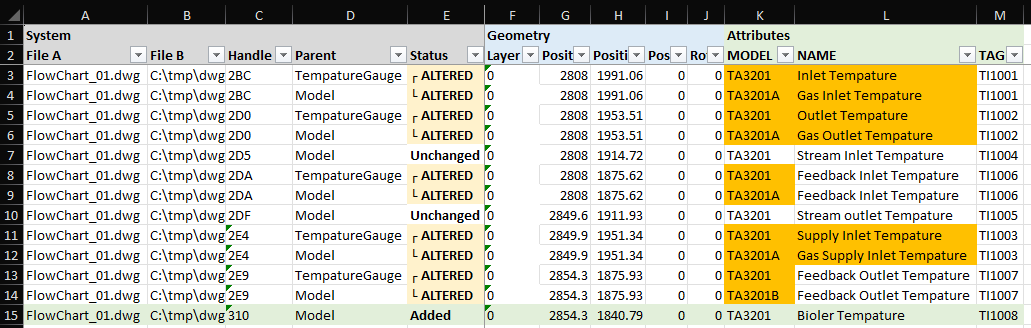
- A Modified instance gets two rows instead of one — the first with its old values, the second with its new values — rather than folding the old value into a comment on a single row.
- The Status column reads "┌ ALTERED" on the first row and "└ ALTERED" on the second, so the pair still reads as one linked unit even after the sheet gets filtered or sorted apart, instead of relying on the two rows staying next to each other.
- Every field that actually changed between the two rows is highlighted (not just noted in a comment), so a reviewer can scan two full rows side by side rather than hovering each flagged cell one at a time.
- Added, Removed and Unchanged instances are unaffected by this choice and stay single-row either way, since there's no "before" or "after" side missing to pair up for those.
Settings
Opened from the gear icon in the title bar. Every field saves immediately — there's no separate Save button.
English / 日本語 / 简体中文. Restart the app for a language change to take effect.
Default: English
System / Light / Dark. Restart the app for a theme change to take effect.
Default: Match system
Which installed AutoCAD version to use first. If it fails to load, the app falls back to another installed version automatically.
Default: Auto (newest installed)
How many drawings AutoCAD can process in the background at once (choices: 1, 2, 4, 6, 8, 12, 16). Higher is faster but uses more CPU and memory — turn this down on a lower-spec machine.
Default: 8
Applies to Add Folder on the Select Files screen, for both Folder A and Folder B.
Default: Off
| Setting | Location | Default | What it does |
|---|---|---|---|
| Language | Settings → General | English | English / 日本語 / 简体中文. Restart the app for a language change to take effect. |
| Theme | Settings → General | Match system | System / Light / Dark. Restart the app for a theme change to take effect. |
| AutoCAD version | Settings → AutoCAD | Auto (newest installed) | Which installed AutoCAD version to use first. If it fails to load, the app falls back to another installed version automatically. |
| Max parallel AutoCAD instances | Settings → AutoCAD | 8 | How many drawings AutoCAD can process in the background at once (choices: 1, 2, 4, 6, 8, 12, 16). Higher is faster but uses more CPU and memory — turn this down on a lower-spec machine. |
| Include subfolders when adding a folder | Settings → AutoCAD | Off | Applies to Add Folder on the Select Files screen, for both Folder A and Folder B. |
Licensing
Your license status shows in the title bar as Free, Pro, Pro (offline), or Expired, and in full on Settings → License.
To activate: paste your license key into Settings → License → "License key" and click Activate. To move a license to a new machine, click "Deactivate this machine" on the old one first, then activate on the new one.
If the app can't reach the license server (no internet), a previously-activated Pro license keeps working for 14 days as "Pro (offline)". Reconnect within that window to revalidate — past 14 days without a successful check, the license shows as Expired until it can revalidate.
Troubleshooting
"AutoCAD not found" or a plugin trust error when the app starts a job
The app drives AutoCAD in the background to open and process each drawing, so it needs a full, licensed AutoCAD 2021–2027 install — AutoCAD LT is not supported. If AutoCAD is installed but this error still appears, that AutoCAD version has likely never been launched on this machine: open it once (even just to the drawing screen), close it, and try again — AutoCAD only trusts a plugin location after it has run interactively at least once.
A row is highlighted red in Review Matches
The filename-only match and the handle-only match disagree about which "after" file this "before" file belongs to. Check the Conflict candidate column, then either accept the proposed match, pick the alternative from the File B dropdown, or Exclude the row.
Scanning seems to hang on a large folder
There's no built-in timeout on the scan step, and no Cancel button during Scan & Match or the Comparing progress screen — if it seems stuck, check Task Manager for a hung AutoCAD background process (a corrupt or unusually large DWG is the most common cause) and the log folder for the last file it was reading. Today, closing the app is the only way to stop it.
A file I added doesn't show up in the Comparison Report
A Folder A file with no confident match starts pre-excluded on the Review Matches screen (no File B picked, Exclude checked) — it's silently left out of Compare unless you go back, pick a File B for it, and uncheck Exclude.
The exported Excel report uses different labels than the on-screen report
This is expected — the Status column in the workbook reads "Deleted"/"Altered" where the on-screen Kind column says "Removed"/"Modified". Same meaning, different wording between the two views.
Re-match on the Review Matches screen doesn't seem to pick up new files
Re-match only re-runs the matching algorithm against the block/handle data already scanned — it never re-reads any DWG. To pick up added or removed files, go Back to Select Files and run Scan & Match again.
Files on disk
Settings → Diagnostics → Open Log Folder gets you straight to the logs if something needs troubleshooting.
| Settings | %LocalAppData%\CADXChange\BlockCompare\settings.json |
| Logs | %LocalAppData%\CADXChange\BlockCompare\Logs\ |
| Filter profiles | %LocalAppData%\CADXChange\BlockCompare\Profiles\ |